Bitten by a dog in Cambodia. Not a good thing, but good
thing I’m on my way to Bangkok where I can go to the Red Cross Clinic for
Rabies within 24 hours. Between the exit office from Cambodia and the entry
office into Thailand is a beach. I asked if I could swim there and I was waved
on down. I haven’t been in the ocean in what seems like years. Ocean water is
good for making me believe rabies won’t immediately consume me. If it comes at
a later time, it’s not that unreasonable, but I hear I’d froth, have paranoia
and chew on table legs. I’d also heard that rabies shots involve thousands of
dollars and massive syringes plunged repeatedly into the abdomen. But then, we
can find any scary story on the Internet and can play with any worst-case
scenario in the depth of a sleepless night. It’s not going to faze me. I’ve
just spent a meditative work/holiday in some of the nicest hidden corners of SE
Asia. I only need 5 shots over the next month. A piece of cake.
May 23, 2012
April 16, 2012
Kampot
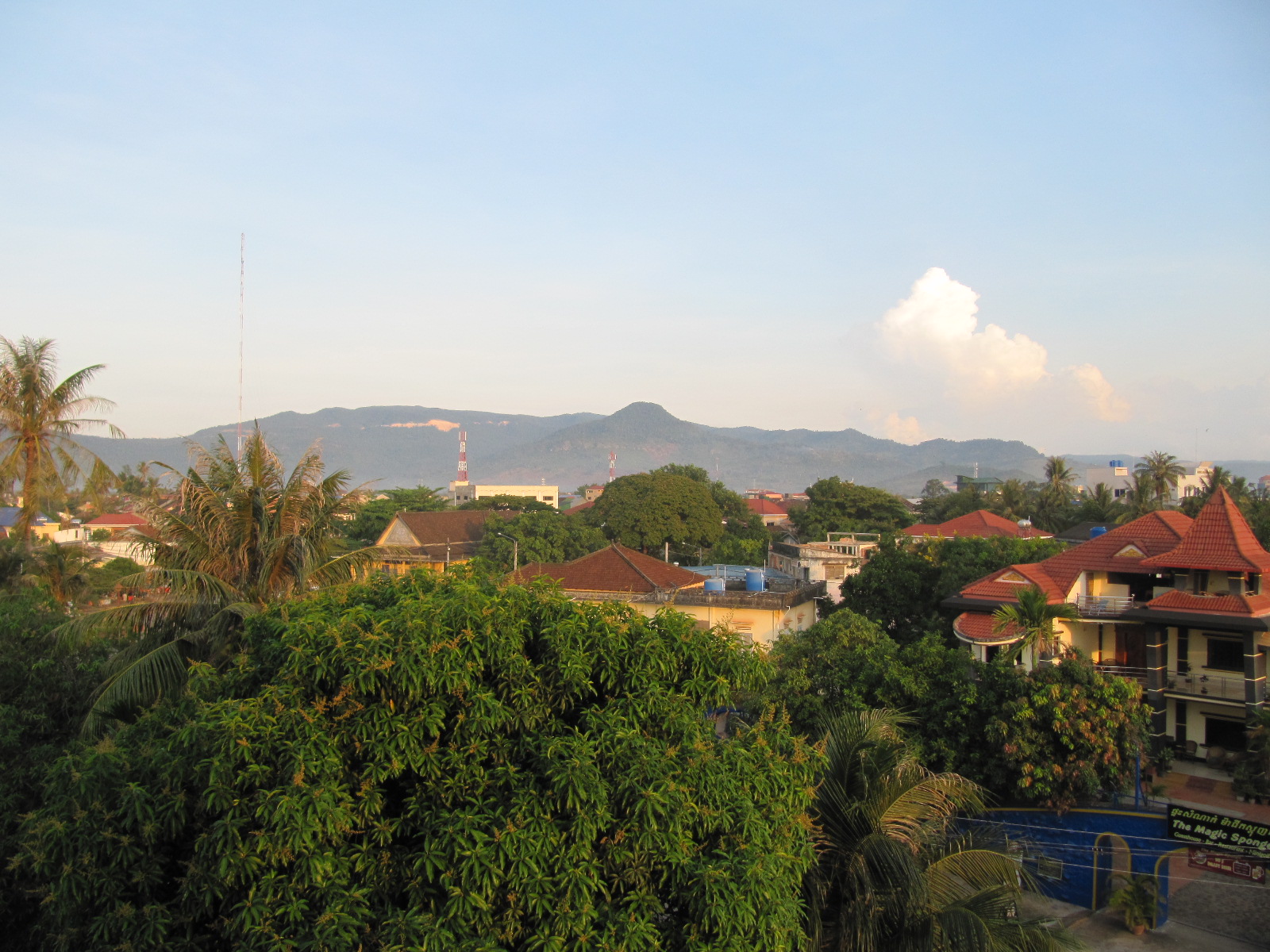
Bliss is finding a $7 room in a perfect little town with a
view like this. If I were to design a SIM town, it’d end up with like Kampot.
Tiny, quiet, fresh breezes and great food. What really makes this experience
satisfying is the all consuming task of making hundreds of FLASH files on my
laptop. Why spend 13 hours a day working at home when I could be doing it in a
small town in Cambodia? Some people say FLASH is dead which is not comforting
after spending so much time on these files, but we’ll find a way. The idea is
to get digital learning materials into rural classrooms. It’s not as simple as
simply connecting to the Internet. We need content tailor made for Laos.
March 5, 2012
game changing
From someone's blog: http://michaelmartino.ca/change-your-game-learning-from-moneyball
Moneyball questions the establishment. It says the wisdom of baseball insiders over the past century is subjective and flawed. Statistics such as stolen bases, runs batted in, and batting average, typically used to gauge players, are a 19th century view of the game.
By re-evaluating the strategies that produce wins on the field, the 2002 Oakland Athletics, with a payroll of $41 million, were competitive with larger market teams such as the New York Yankees, who spent over $125 million.
Several themes the movie touches on are:
- insiders vs. outsiders (established traditionalists vs. upstarts)
- the democratization of information, and
- the ruthless drive for efficiency.
You have to be smarter than the competition. Hard work is not enough - you need an edge.
How can you question the establishment and win?February 24, 2012
Again lurching forward
I’m back. In fact, I’m back to Luang Prabang after more than two years. I’m surprised that people remember me and that I still see my books around. I dreaded coming back to deal with the accounts because on the last visit, a school director practically threatened me when I tried to collect. I’m trying to swallow the losses and move on.
It’s been a good week, but I’m not sure if portals are opening or if it’s yet another revolving door that dumps be back out in the cold. I’m led to believe that I have the green light to introduce English programs at the University of Health Sciences, the Provincial Hospital, the largest high school in the city and the University at Luang Prabang.
They don’t flinch when I mention books. (Maybe they’ve had two years to look over them and people practically reach out to grab when they see the digital files. It’s the combination that I’m betting on. Digital files will cover the problems of resources, lesson planning, teaching training, testing … or sort of.
And I’m still introducing sign language. It didn’t fly that well with high schools students, but their teachers loved it. At one point I realized that teachers thought that every time I moved my hands they were actual signs and I could see people imitating them, So now they may think they know sign language for, “You know, anyway, of course.” I still love the magic of sign language. It makes people smile.
Books everywhere
One image that moves me to tears is to see so many people reading. The number of newspapers has exploded and judging by the pictures of Aung San Su Kyi on all of them, I figure censorship has been lifted. There are blocks and blocks where vendors set out their books for sale on the streets and I can see men, women, older people and children all looking them over. Most are used and under $2. It’s not like they’re interested because the most recent best seller is out, they must be interested because they’re in the habit of reading anything and feel starved if they don’t have enough. C’mon Laos.
Shwedagon
It’d been waiting for decades to go to Myanmar. I told myself that if the country were to ever decide that draconian nastiness is not the way to make international friends and if Aung San Su Kyi were released, I’d go. Many others seem to think the same. The timing is right. Yangon was rapturous.
Go get money from the Gates
I’m surprised at how many times people suggest that I go get money from the Gates. They have created a benevolent image so convincing that people think it’s just a matter of giving them a call. “Hey Bill, can I hit you up for some cash?”
Their new interactive exhibition space across from the Space Needle has created stir. Of course it’s beautiful and dutifully digital. There are some weighted buckets that help you imagine what it’s like to carry your daily water from the well. Statistics are mounted big-size so the impacts are more dramatic.
The irony for me is that no amount of statistics or interactive lessons are going make the problems of development hit home while walking through a gorgeous Seattle exhibition space. They put photos of world toilets on the stalls, but they could have gone the whole mile with squat toilets, no toilet paper and mosquitoes. Instead of all that environmentally sustainable polished wood, they could have made a wall of slivers or simply named the video room, “The Room of Guilt”. OK, but that’s just being me.
Happy New Year 2012
The year begins with a deep freeze in Seattle. Cars skid off the road, wires drop, snow melts and freezes back into tectonic plates. It’s beautiful and a finger-wagging reminder of how vulnerable we are.
I don’t have to be reminded. The floes of possibilities and disappointments in Laos can’t be predicted. Sometimes it’s just a wet foot, punching into a thin patch of ice, but at other times it’s like looking out onto a sudden expanse of open desolate water. There is nowhere to go and I get a deep chill thinking about the whole sheet under my feet cracking and melting away. That would be a cold plunge.
December 12, 2011
Can you possibly believe this?
WWF reports that a new species is discovered every two days in the Mekong region. Can you believe that? Among the ten species highlighted in the WWF report is the snub-nosed monkey (Rhinopithecus strykeri). Found in Myanmar’s remote and mountainous Kachin state, locals say the monkey can be spotted with its head between its knees in wet weather to avoid rain running into its upturned nose.
A staggering array of 28 reptiles was also newly discovered in 2010, including an all-female lizard (Leiolepis ngovantrii) in Vietnam that reproduces via cloning without the need for male lizards. Five
species of carnivorous pitcher plants were also discovered across Thailand and Cambodia, with some species capable of luring in and consuming small rats, mice, lizards and even birds.
This only confirms the biodiversity of the human race as you might know humans who hide their heads between their legs when it rains, all- females who reproduce through cloning and people who use pitchers to eat rats, mice lizards and even small birds.
A staggering array of 28 reptiles was also newly discovered in 2010, including an all-female lizard (Leiolepis ngovantrii) in Vietnam that reproduces via cloning without the need for male lizards. Five
species of carnivorous pitcher plants were also discovered across Thailand and Cambodia, with some species capable of luring in and consuming small rats, mice, lizards and even birds.
This only confirms the biodiversity of the human race as you might know humans who hide their heads between their legs when it rains, all- females who reproduce through cloning and people who use pitchers to eat rats, mice lizards and even small birds.
November 10, 2011
Children reign
Catapulted from Savannakhet to an alternative school in Vientiane. My first day was with 36 seven year-olds. The din was so loud some children were trying to protect their eardrums. It was home alone.
So at first I thought seven year-olds were a pain, but only because I could imagine them as the adults they would become. Strange how a pudgy seven year-old could so easily morph into a beer-bellied slob – in my mind.
Then, I started to understand them as children, not as misbehaved adults. I started to appreciate the excuse I had to experience delight as a child. Mind you, I’ve never sung in public before, but singing and dancing is at the core of being a child. Now, I’m the elementary school teacher looking for puppets in the market and sifting threw garbage bins for good arts & crafts materials.
Let’s do a curious Benjamin Button and see if we can design a curriculum where children grow up to be responsible and capable adults without losing their divine delight of being.
October 7, 2011
The good and the bad
The good can be good and the bad can be really bad. Shall we play the “Let me top that story” game?
So I heard about this teacher. He went to class drunk. That’s not surprising because many teachers drink before their evening class so it’s likely that some are drunk, right? Well, he was probably drunk enough to slur his consonants and the students couldn’t understand him though he’s pretty incomprehensible anyway. So someone asked, “Teacher, have you been drinking?” or maybe more directly, “Teacher, are you freak’n drunk?”
I guess he was because apparently he slammed his fist down on the desk and continued to rant and rave for the next 30 minutes. In retaliation, he gave the students a hopelessly difficult passage to translate (probably something he wrote himself) and then failed them all. How come nobody got that on a mobile and let it go Lao viral? Or did someone forget to flush?
October 5, 2011
Rocking and Rolling
No time to lick my wounds. Schools in Vientiane are lining up for training in signing. Years ago, I was doing dental work, trying to get teachers to work on their “skills”. Now, school directors are fully onboard and students are rockets at the pad.
I visited a school and everyone greeted me in sign language. I was flabbergasted to see a girl practicing signs during the flag raising ceremony. From 50 yards away, I could see her saying “go home, white, mango”. Then they spotted me and we greeted each other though I was three floors up and behind a pane of glass.
The teacher thought it would be easier to gather the 7 and 8 year olds together so here I had more than 100 children. Maybe this was some kind of record. We had a mini rock concert and I didn’t even need a mic. No electric guitar either.
September 17, 2011
Rice is growing
Rice is growing, green and tall. Or at least in some places. This is the year of devastating floods and much of the rice has drowned. What do people do when they don’t have rice? I’m not quite sure.
Rice is growing green and tall. That is, if it can survive. Anything can grow green and tall if given the chance, if not choked off at the roots or smothered at its tips.
If people know that rice can grow green and tall, it really takes someone hideous to cut it early, dry it and sell it for private profit as pig feed.
On the other hand, the desire for an easy buck is easy to explain. What could possibly motivate someone to snip roots or smother leaves just for the sake of doing so? Can they be forgiven because they don’t know, even if it’s their chosen profession to raise rice?
I’m searching for a place where rice can grow because I am convinced that all students can grow green and tall.
August 23, 2011
Reaction in Progress: Indicators (continued)
The definition of indicator has something to do with pointing fingers. Yes, I do that sometimes. But I’d like to offer a simple indicator to measure the quality of a teacher. Measure the minutes. How late are they?
The typical teacher is around 15 minutes late. If they leave the teachers’ room 5 minutes late, it’s perfectly reasonable and then if the classroom is far away, another 10 minutes is quite sensible. It’s hot. Why rush?
I worked in Japan for 15 years. It is in my system. My blood changes color if I’m late. In the 15 years I worked in Japan, I remember being late one time.
I know a few teachers who are not late. One says that his time to teach is never enough. He even finds ways so as not to waste time taking attendance. He knows each student by name and is proud that he instilled confidence to learn in every student. Giving students confidence requires planning and monitoring, consulting and amending and this takes time.
I was surprised with another teacher when I found him in class before I arrived. It happened more than once. What’s going on? I noticed a qualitative change in him. Rather than give tests with questions like, “How many personal pronouns are there in the English language?” to students who admitted that they can’t even write the alphabet, he negotiated with them. “What can you do? What do you need?”
The students agreed on clear and reasonable goals and rose to the challenge. The teacher gave them an oral test and looked at me repeatedly in surprise at what the students could do. Seeing students thrive on success rather than be browbeaten by defeat is something I suspect most teachers don’t see, don’t look for, don’t recognize and surely don’t cultivate. This one teacher was delighted at what he saw and I’m sure that is what brought him to class on time.
Back to indicators, I won’t argue with the number crunchers, but maybe we should just use definitions of “indicators” from chemistry or biology. Both are quite useful.
“A compound that changes color at a certain PH value or in the presence of a particular substance and can be used to monitor acidity, alkalinity or the progress of a reaction.”
“An animal or plant species that can be used to infer conditions in a particular habitat.”
Indicating the indicator
I hardly think I can get you interested in downloading, “Indicators of Educational Development: Concept and Definitions www.educationforallinindia.com/.../ ..”, but you might glance at the pretty diagrams and the techno speak.
Even the guy at the ice cream shop was asking me, “What are your indicators? At what level do you feel you’ve succeeded in what you’re trying to do? How do you determine that education has improved?
Strange that in the same day a half naked man at the herbal sauna asked, “Give me a number. How far do you think you’ve come? Ah, forget the abstract numbers. Considering your effort, you’ve got to be at least 50% there.”
That’s how well I’m known. That’s how much some people are concerned of my sanity and that’s how futile many people think the whole thing is.
Nobody really knows how to measure things. You can’t measure a stench. In this paper, with all the pretty diagrams and mind-bending formulas, there is only one short paragraph for indicators on educational quality. It’s easier to measure access to a school in inches and yards, how many schools have toilets, how many students enroll and how many drop-out. When it comes to quality, this is a quote:
“The indicators of coverage and efficiency fail to give any idea about children completing an educational level and also the level of their educational attainment.”
This sentence is even better: “Educational attainment is measured in terms of learners’ achievement. Learners’ achievement is also considered one of the important indicators of quality of education.” (I think this is a tautology, but I go cross-eyed first.)
Furthermore: “In India, data on learners’ achievement is not available on a regular basis, as the same do not form part of the regular collection of statistics.”
So even after this disclaimer, the report spits up its indicators of educational quality that include; “completion rate”, “gross completion ratio”, “net completion ratio” and “graduation rate”. Pardon my English, but this is so stupid. In Laos, it should be, “gross rate of complete inability to communicate in English despite being awarded an A and an advanced degree.” Oh, come on. Completion rate depends on how much you pay. Everyone knows that.
August 19, 2011
Battle over words and minds
Words, definitions in particular, can be used to challenge conventional thought. What term took on the idea that all legitimate learning only happens in schools? I would vote for the all too unimaginative term, “non formal education.” There are even disputes as whether to use a hyphen or not.
The “socio (hyphen) cultural accepted norm” for learning was first challenged by Scribner and Cole in 1973 according to Wikipedia (http://en.wikipedia.org/wiki/Non-formal_education). They said, “Most things in life are better learnt through informal processes, citing language learning as an example.” They encouraged us to look at what happens in indigenous communities for more proof.
There is no such thing as an exciting term without an agenda. What’s in it for who(m)? For starters, online distance learning programs could issue PhDs in “life learning” for those who like to travel to places like India. There’s got to be a market for that.
If this is the case, the desire for certification takes us back to formal education and the reason most people endure insufferable years in a classroom.
How has the term been mined in development work? There’s not much sense in awarding degrees for rice farming. Instead, organizations can cull money for “non formal education” projects in literacy for adult learners. I’ve heard first hand that this is much harder to accomplish than it sounds, but it looks wonderful on paper.
The convenience of this funding is that it is done outside the formal schools, a place that is wrapped in red tape and almost impossible to change. However, at the end of the day, we need to consider that many adults are illiterate not because they didn’t go to school, but because they went to school.
So it all depends on how you define the term and why you even bother. If for example, we define non formal education as an activity that people do because they want to learn and enjoy doing so, regardless of the degree they get, it means non formal education should be happening in formal education.
If you find this confusing, come to Laos. It’s not difficult to understand.
July 3, 2011
The warp and the weft
Culture clash is unavoidable. I’m sure there are people who think Martin is from Mars. I always say our common goal of quality should overcome our differences though that may be innocence itself.
There’s a Lao company that produces hand-woven cotton. They’ve been approached by a major Japanese retailer with orders in the tens of thousands. Sounds great, but we’re working with different standards; Mars and Neptune. In village, there are funerals. Then, villagers can’t weave. Nonetheless, the Japanese company wants updated Excel spreadsheets on time. Otherwise, they’ll have heart attacks.
Apparently the company CEOs visited the village and were entranced. Here were villagers weaving to the sound of rain and frogs croaking. Chickens at their feet, the smell of soil. “Hand woven cotton from a developing country! This is it!” It’s green, it’s ethical, it’s developing country. It’s got to sell. Then the project managers came and were appalled. “You can’t weave with all this dust! What are you going to do about the chicken shit? We need quality!”
You can’t have your cake and eat it too. You can’t have your organic hand woven cotton from a developing country delivered on time with Excel spreadsheets. They should have known better.
For me, the quality in this fable is not about expedient shipments for a major company trying to make a profit off of romantic cheap labor. For me, it’s the heroism of the Lao entrepreneur. Against all odds, if she can pull this off, she’s done something historic.
June 29, 2011
Spoiled meat
It may be the same for any level of professional incompetence. It’s not that hard with English. If the teacher keeps students in the dark, students don’t even know how incompetent the teacher is. It’s harder to bluff one’s way through with computers. I guess that’s why they just keep the room locked.
I have seen graduates from overseas MA programs typing with two fingers. Some people can type quickly with two fingers, but these people could not. At the rate they were typing, it would take three years to type the first draft of a dissertation. No wonder I’ve never gotten email from them.
When it comes to teaching computer programs, a sufficiently confusing explanation will keep students clicking aimlessly. Then the teachers can just blame them. “See? Students from the countryside don’t know anything.”
Who is it that doesn’t know anything? I heard that an international organization paid big bucks for teachers to train in computer literacy in Vientiane, innocently letting the school decide who could go. They came back with two fingers, but that was about it. But that's OK. At least it's not spoiled meat.
June 25, 2011
Harmonious circles
I was told years ago that garbage is cultural. “Martin, it took years even in developed countries for people to stop littering.” I don’t know about the anthropological evolution of littering. I just know that I hate a dirty classroom.
I’m not an order freak. I’m just interested in how people interact with their environment and how that affects learning. If students treat classrooms like garbage dumps, they probably assume that’s what they’re receiving too.
Likewise, there is the sociology of chairs. People choose where they are comfortable sitting and will not budge. Move the chairs and some are ready to sit on the floor rather than move. The most radical configuration is a circle. Lao classrooms are not familiar with circles. I’ve seen circles turn into squares and go concentric in order to create a safe back seat.
Once students get used to it, life is different. They look at the teacher. They stop using their phones. They talk to each other. Circles are equalizing, democratising and harmonious. Rather than an ox cart with slow students dragging the rear, circles spin in forward momentum. With circles, there is a happy hum among the students. It’s the sound of satisfied learning.
June 7, 2011
No exit
This is from a final paper, submitted by a graduating student at a Teacher Training College.
General information about teaching and learning of KLSS is the technique of teaching and learning not enough and perfect for both teachers and students. Moreover, most of the teachers are old or senior
It passed, but how? Should it fail because it is indecipherable? Should it pass because the next passage is perfect?
In order for students to communicate well they need to have to expand their Cognitive Academic Language Proficiency level (CALP). CALP contains the genres of power that leads to success.
Pass/fail is not that simple. Nor is true or false. Are these statements true or false?
T/F 1. The text is inscrutable/perfect to everyone because someone was paid 2,000 baht to write it.
T/F 2. The paper passed because the teacher wrote it.
T/F 3. Even if the student wrote it, they’d have to pay 2,000 baht to get it checked.
T/F 4. The students are taught gobbledygook for three years so that nobody knows better.
Look for the answers in a future blog. Or just read past ones to figure it out. Got any CALP? If it contains the genres of power that lead to success, where can we get it?
Subscribe to:
Posts (Atom)